Gaia alerts validation with the G.D. Cassini Telescope
(Loiano)
confirms Gaia14aae to be the third known eclipsing AM CVn
(a candidate SN Ia progenitor).
Gaia14aae (ASASSN-14cn) was detected by Gaia on 2014-08-11, during an outburst.
Low to intermediate resolution spectra taken at the 4.2m William Herschel Telescope on La Palma, over the nights of 13-15 October 2014, using ISIS+R300B/R158R and ACAM+V400, show double-peaked He emission lines at z=0, with no H. 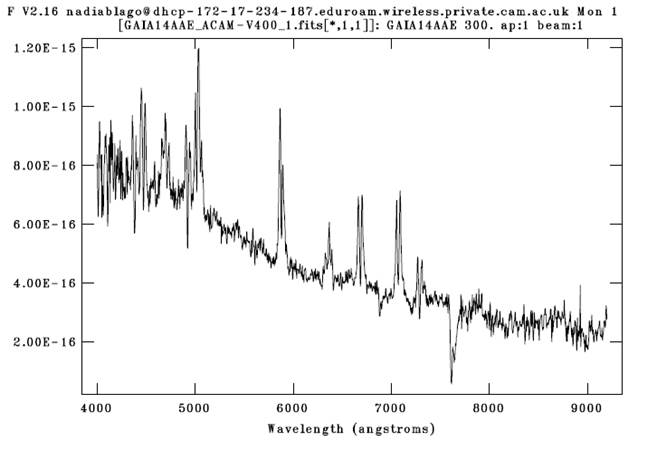
Such spectra allowed classification of Gaia14aae as a AM CVn system, a very rare class of object (see Atel 6593). AM CVn systems are ultra-compact, semidetached, white dwarf binaries with periods ranging from 5 to 65 minutes. The prototype (with an orbital period of 17 min.) was discovered in 1967 (Smak J., 1967, Acta Astron., 17, 255) and Bohdan Paczynski (1967, Acta Astron., 17, 287) proposed the system to be a very short period binary with a degenerate, helium-rich donor in a very tight orbit.The theory of general relativity predicts that such systems would emit gravitational waves and lose angular momentum. This drives mass transfer from the lower-mass (bigger) white dwarf to its companion. Despite the loss of angular momentum, the redistribution of mass makes the binary orbit widen and thus leads to an increase in orbital period.Since the 1960s only a few dozen members of this class have been discovered, with periods up to 65 minutes. In the meantime theoretical models on how to bring two white dwarfs (or white dwarf like objects) in such close orbits have been developed. The small number of known systems, however, makes it difficult to test the viability of the different models.Photometric data acquired on October 24, 2014, with BFOSC at the 1.5m G.D. Cassini telescope in Loiano (Italy) and CBA data by E. de Miguel confirm that Gaia14aae is indeed an eclipsing system, with a period of 49.7 min., hence the third known eclipsing AM CVn (a possible SN Ia progenitor). 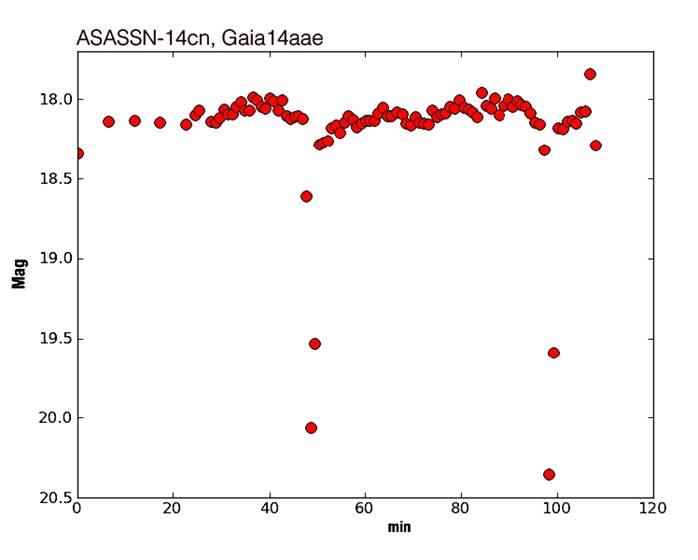
Caption: Light curve derived from 98 frames obtained with BFOSC@1.5m LoianoTelescope in the Gunn g band, with exposure times of 420, 300 and 30 sec BFOSC data have been also used to create this time lapse, shrinking 88 mininto a 21 sec movie, that very clearly shows the system’s deep eclipse. 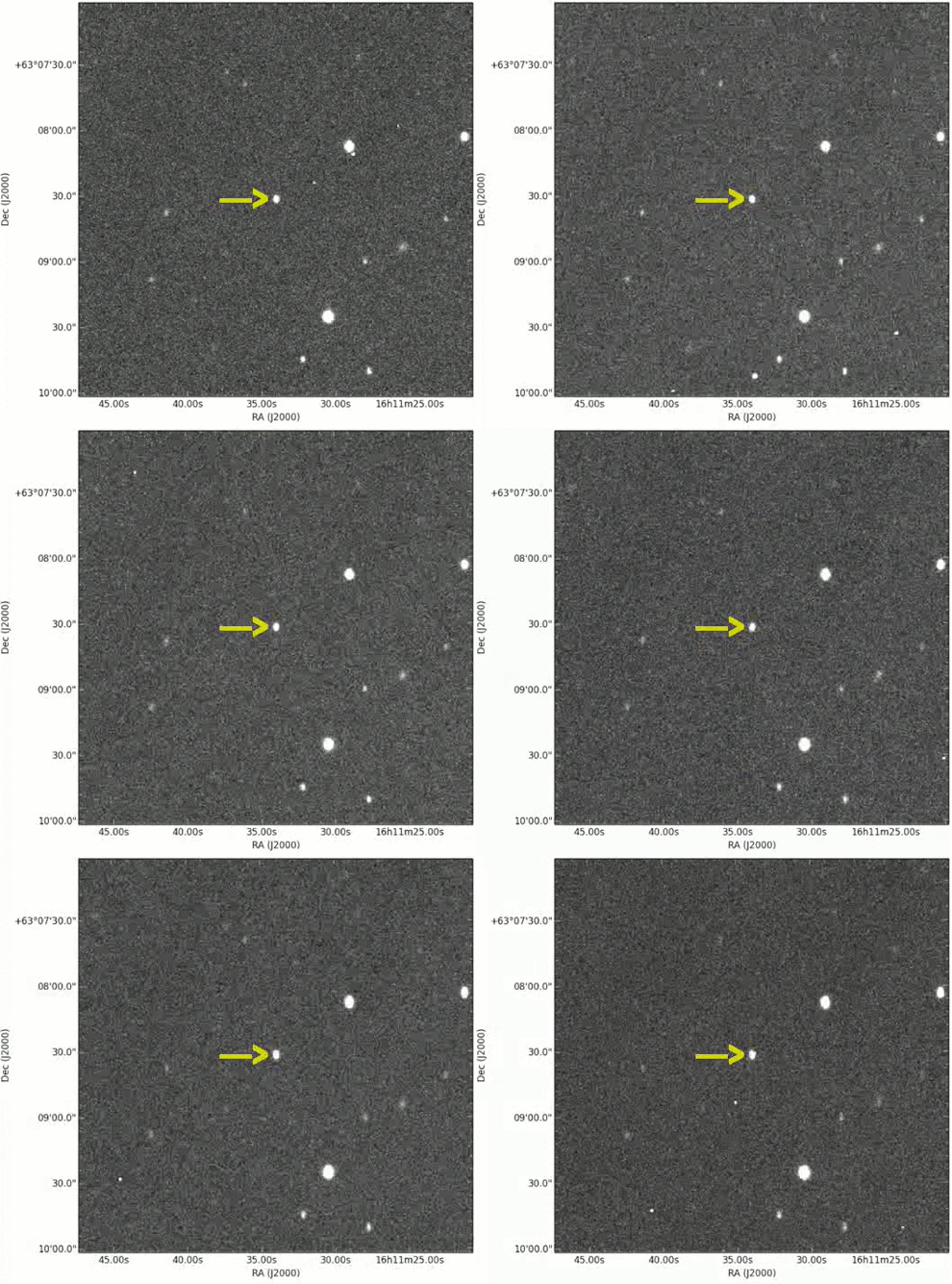
Proposal PI: Gisella
Clementini, CoIs: Lukasz Wyrzykowski, G. Altavilla, S. Hodgkin
et al.
Observers: H. Campbell,
K. Rybicki, P. Wielgorsky, R. Gualandi
Reduction and observing strategy S.
Hodgkin